In the demanding realm of modern pro-level oversteer competition, victory is far more than solely a product of sheer horsepower or pilot aggression. Instead, it has evolved into a multifaceted science that requires a scrupulous fusion of choosing a time-tested car, equipping it with the most precise competition components, and, most importantly, grasping its live behavior on the circuit through sophisticated drift telemetry software. This exhaustive handbook functions as your blueprint starting from the initial concept of a drift build through to the final telemetry-optimized tweaks that transform a strong machine into a repeatable podium finisher. We will examine in detail the methodical process of car suspension tuning, illustrating how a state-of-the-art suspension tuning tool like precise measurement hardware removes approximation and provides unparalleled visibility into your vehicle's actual performance.
The bedrock of any exceptional drift car is, without question, the chassis itself. Certain platforms have achieved legendary status within the global drifting community due to their inherent balance, robust design, and the enormous availability of specialist parts available. Picking the correct car is the first and most crucial selection a driver will make. As an example, the BMW's E36 3 Series is universally acknowledged as among the best balanced cars for drifting of history. Its almost ideal 50/50 weight distribution, coupled with a driven rear axle configuration and extremely reliable inline-six motors, establishes a platform that is both easy to handle for novices and highly effective in the control of a professional competitor. The next step of this concept, the BMW E46, refines these attributes with a more developed structure, wider wheel track for enhanced confidence, and still more turning capability directly from the OEM. A different formidable option in the pro scene is the C6 generation Corvette.
This American performance car brings a distinctive set of strengths to the sliding sport, including a low-mass aluminum frame, a rear-mounted gearbox and differential unit that contributes to an ideal front-to-rear mass ratio, and the immense thrust of a large-displacement LS V8 motor. This fusion makes it an complete weapon on track, able of entering and maintaining extended angles with seemingly easy deployment of power. For drivers desiring exceptional bang-for-the-buck, the Nissan Z33 stands out as a top-tier candidate. It is delivered from the factory with a rigid platform, a decent factory LSD, and the responsive V6 engine that provides sufficient performance for practicing and progressing in the sport. Its newer version, the Nissan Z34, brings further improvements in body strength, handling precision, and peak engine output, cementing its position as a popular pick among competitive drivers. Additional historic vehicles that warrant mention include the lightweight Wankel-engined FC generation RX-7, the most popular S13 Silvia/240SX, the American Ford SN95, the electronic-equipped BMW E90, and the tiny yet surprisingly engaging and instructive MX-5 Miata. Every single one of these cars offers a distinct array of traits, difficulties, and capabilities, but they all share the fundamental ingredients necessary to become a serious sliding vehicle.
However, picking the optimal platform is only the beginning. To unlock the complete performance of every of these machines, substantial upgrades to the steering and suspension systems are absolutely essential. This is where the world of specialist tuning components comes into sharp focus. The most most game-changing improvement for a purpose-built drift machine is the fitting of a high-performance drift angle kit. These advanced systems, such as those developed by performance brands like SLR Speed, are created to dramatically increase the vehicle's maximum steering angle. A OEM road car is extremely limited in how far its front wheels can turn, a safety trade-off for on-road driving. In sliding, however, maximum countersteering is continuously needed to control and hold a slide. An angle kit exchanges the factory uprights, tie rods, and often suspension arms with components that permit the steered wheels to achieve steering lock beyond 70 or even 80 degs, compared to a normal stock setting of around 40 to 50 degs.
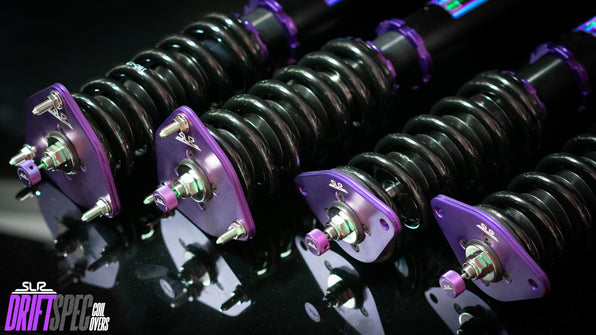
This vastly greater steering angle offers the driver with significantly greater authority during a drift, making it much easier to start a drift, maintain it through a extended bend, and transition seamlessly from one side to the other. The improvement in drivability is absolutely revolutionary. Combined with a correctly specified angle kit is the just as essential enhancement to the car's suspension. Generic or including high-end sport coilovers are just not designed for the particular and harsh demands of sliding. A drift-spec system of adjustable dampers is paramount. These specialized dampers have custom damping rates and spring strength that are designed for the rapid mass transition that is characteristic of sliding. When a operator begins a angle, the vehicle's mass is transferred rapidly to the front of the bend. Optimal performance coilovers manage this movement in a controllable manner, allowing the car to settle quickly and offering the operator precise response through the steering wheel and driver's seat. They furthermore provide accurate setting of stance, shock absorber rate, and weight balance, which are all fundamental elements of optimizing the chassis's behavior to a particular circuit or piloting style. Together, a top-tier angle modification system and a expertly selected system of drift-spec coilovers are the absolute mechanical cornerstone upon which all future optimization is constructed.
Once the core parts is in place, the subsequent critical step in the project is the meticulous setting of the chassis's suspension geometry. This is the realm of car suspension tuning, a methodology that can appear daunting to the uninitiated but is, in practice, the secret to transforming a set of fast pieces into a unified and predictable machine. The most critical element of alignment for drifting is undoubtedly negative camber. Camber is the inclination of the tire compared to the upright axis when observed from the front of the chassis. When the top edge of the wheel is angled inward, this is referred to as negative camber. In drifting, inward-leaning wheels on the front axle tires is generally applied and is considered critical. The reason is intrinsically tied to tire contact.
When a car is going around a bend at extreme slip angles, the body leans to the outside of the corner. This body roll makes the outer front tire to reduce its best footprint with the asphalt. By introducing an inward tilt, the wheel is pre-tilted to counteract this tilt. As the car rolls into the bend, the tire becomes more upright with the road surface, increasing its bite at the precise time when it is absolutely essential for control. Usually, front axle adjustments for a dedicated drift car vary from approximately -3 degrees to as high as -5 degrees or even more, contingent on the specifics of the chassis configuration, rubber type, and operator preference. The rear wheels also employ negative camber, but the angles are usually less and subtler than the front. Too much negative camber at the rear can cause the vehicle to overly tail-happy and challenging to manage on acceleration input, as it reduces the effective contact patch of the driving wheels during straight-line acceleration. Therefore, rear camber settings are often in the range of -1 degree to -3 degrees, finding a delicate balance between providing enough cornering grip to help in initiating and holding the drift while simultaneously keeping usable hook-up for exiting the corner. camber angle is only one part of the more complex alignment picture, which also involves toe setting, self-centering steering, and bump steer correction.
Toe refers to the orientation of the tires as seen from the top. Inward toe means the front edges of the tires are nearer together than the rear edges, while toe-out means the converse. For oversteer, a slight amount of front toe-out is commonly employed to sharpen the initial directional feel, making the chassis feel more nimble and eager to begin a drift. Rear toe angle is usually set to zero or a incredibly small amount of inward toe to foster straight-line stability under power. Caster is the longitudinal or backwards inclination of the suspension pivot when viewed from the lateral of the car. Positive caster angle improves steering feel and high-velocity stability, and it furthermore increases camber increase during cornering, which is very advantageous. Tuning these parameters is a complex dance where a adjustment to one parameter can and will impact the others. The old-school method for tuning a car's suspension geometry for drifting has historically been a time-consuming endeavor of experimentation and feeling. A pilot or team would apply a change based on intuition, run the vehicle on track, depend on the pilot's individual perception and comments, and then make another tweak. This loop would iterate again and again until the chassis felt "good" or the allotted practice time ran out. This approach is not just extremely wasteful in terms of man-hours and tires, fuel, and parts, but it is also inherently imprecise.
Pilot feel is a infamously subjective data source, colored by numerous variables such as tiredness, varying track grip levels, ambient heat, and just the mindset of the operator on that particular run. What feels "oversteery" on one pass might feel "tight" on the next pass, leading to conflicting information and frustrating adjustments. This long-standing challenge in car suspension tuning is specifically where state-of-the-art technology has stepped in to completely change the process.
The rise and integration of specialized drift telemetry software has brought about a completely new age for engineering and optimizing competitive drift cars. These tools, showcased by cutting-edge systems like data acquisition tools, function by directly measuring the real-time physical performance of the vehicle as it is being driven on the track. Unlike relying on subjective feedback, these tools gather objective information on essential factors such as suspension travel, wheel speed, acceleration forces, steering angle, and driver input position. This acquired telemetry is then analyzed by powerful applications that can plot and decode the metrics in a clear format. For the first time ever, tuners and crews can observe specifically what the chassis is performing at any given moment of a drift. This capability revolutionizes the complete chassis setup procedure. Consider the particular challenge of optimizing the front axle camber coilover setup tips for a specific car. Instead of introducing a adjustment from -3 degrees to -3.5 degrees and then testing many laps to try and "perceive" a difference, a telemetry system can give real-time and definitive data. The tool can display in a chart how the wheel's loading is acting during the most important moments of a angle: turn-in, holding the angle, and transition. It can demonstrate if the existing camber setting is enabling the steering tire to maintain ideal grip or if the compound is overloaded on its external edge.
The tool can after analysis make fact-based recommendations for change. Perhaps the information shows that the outside front tire is even overloading its sidewall at -3.5 degrees of negative camber, suggesting that an increase to negative camber, say -4 degrees, might be advantageous. Alternatively, the information might show that the tread is not reaching optimal operating temp or that the inside shoulder is wearing unevenly, which could point to that there is too much inward lean and a modest lessening back to -3.2 degrees would be more ideal. This level of accuracy and useful insight was literally impossible in the era of pure seat-of-the-pants tuning.
The effect of employing a comprehensive suspension tuning tool reaches well beyond merely dialing in camber. It serves as an priceless damper adjustment manual that is tailored to your exact vehicle. When fine-tuning the shock absorber clickers on your coilovers, instead of depending on imprecise tips or replicating another car's numbers, you can employ the software to analyze how the chassis is behaving in response to your adjustments. The software can show the suspension travel path over a run, highlighting if the coilovers are handling the chassis motion optimally or if they are allowing the car to bounce excessively after a flick. It can aid in pinpointing problems like hitting the bump stops or losing droop, allowing you to make informed adjustments to helper springs, rebound/compression settings, or ride height. This process extends just as coilover setup tips well to the intricate task of car alignment tuning. In addition to camber angle, the tool can provide analysis into how modifications to toe and caster are influencing the car's handling during various maneuvers of a lap. For example, it can car suspension tuning help you to find the ideal amount of front negative toe for your particular steering geometry and piloting style by showing the quickness of initial reaction and the consistency of the vehicle at maximum steering angle. This transforms the tool an incredibly effective vehicle dynamics manual that is dynamically informed by the actual dynamics of your own chassis on the circuit. It elevates the whole project from a mysterious craft into a repeatable optimization exercise.
Additionally, the utility of a tool like GripDial is not at all restricted to professional tuners with extensive budgets. For the club-level driver, it serves as an incredible equalizer. It in essence provides the tuner with the insight of a full-time race engineer without needing the typical cost. It speeds up the learning curve by giving definitive answers to problems that would normally take seasons of trial and error to answer. A tuner can learn how their particular vehicle responds to various adjustments, gaining a deeper comprehension of suspension theory in the journey. It also makes accessible advanced performance tuning concepts, enabling every enthusiast with the ambition to refine their vehicle to achieve it in a efficient and successful manner. This is particularly important in a discipline like sliding, where engineering expertise has in the past been a closely guarded commodity among elite drivers. Today, that capability can be in the garage of every motivated builder.
In the final analysis, the process to constructing and tuning the ultimate competitive drift car is a multi-stage endeavor that seamlessly integrates classic mechanical principles with cutting-edge digital solutions. It commences with the informed pick of a legendary platform, then enhanced by the integration of essential drift-spec components like maximum-angle drift angle kits and correctly specified drift-spec coilovers. The build then moves into the precision phase of alignment optimization, where settings like camber, toe, and caster angle are carefully set to match the chassis's upgraded geometry and the driver's specific needs. Ultimately, and what truly separates the today's methodology from the past, is the use of a powerful vehicle dynamics tool. This tool eradicates the uncertainty and inefficiency of only feel-based tuning by giving quantifiable, real-time information on how the car is actually functioning. It serves as an indispensable diagnostic aid, a comprehensive drift suspension tuning guide, and a comprehensive vehicle dynamics tool. As a complete package, this integrated approach ensures that all element of the drift car—from the pick of the platform to the final click on the suspension—is refined for peak performance on the competition venue. It signifies the full maturation of the sport of oversteer driving, bridging physical driving skill with surgical suspension engineering to build the most competitive machines imaginable.